October 5, 2026
Re: Open Letter to School Districts, District Leadership, and School Boards
Dear School Districts, School District Leaders, and School Boards (the “Districts”):
As the 2026-2027 school year begins, the below-signed organizations and experts on technology in schools write to address four important and time-sensitive matters.
First, to inform the Districts of recent litigation developments and public reporting concerning student use of YouTube, Gemini AI, and the internet on school-issued devices—which have crystalized the dangers they pose to students and the legal risks they pose to the Districts.
Second, to request that the Districts disable YouTube on school-issued devices.
Third, to request that the Districts disable Gemini AI on school-issued devices.
Fourth, to request that the Districts investigate student internet use on school-issued devices, share the results with the public, and reform their policies to ensure student safety.
I. Litigation Developments and Public Reporting Related to YouTube, Gemini AI, and Student Internet Use on School-Issued Devices.
The Districts have purchased millions of laptops and other devices for their students, typically on a 1:1 basis. These devices are often used to access Google’s Chrome browser and Google Workspace for Education (GWFE) services, such as Google Slides, Gmail, and Gemini AI. YouTube, Google’s video player, is also accessible on many school-issued devices.
Unfortunately, as shown below, Google consistently argues that Google is legally untouchable for harms to students allegedly caused by its products on school-issued devices. When families have alleged their children were harmed by Google products on school-issued devices, Google consistently blames school districts. Google is looking out for its own interests. Therefore, the Districts need to look out for their interests, and their students’ interests.
a. Many of the Districts Have Already Sued YouTube For Allegedly Addicting and Harming Their Students.
Many of the Districts have already sued YouTube for alleged harms to their students caused by YouTube’s allegedly addictive and dangerous product design. Over 1,000 of the Districts, collectively charged with educating millions of students, have filed “short form” complaints in the Multidistrict Litigation (MDL) against social media companies, including YouTube, thereby joining in the “master complaint” brought by school districts and local governments. A sample short form complaint is attached as Exhibit 1,1 and the master complaint is attached as Exhibit 2.2
By signing onto the national lawsuit by school districts against YouTube, many of the Districts have joined, and adopted as their own, over three hundred pages of devastating allegations in the master complaint against social media companies, including YouTube. These allegations include over thirty pages of specific allegations concerning YouTube, including:3
- “Compulsive use of YouTube by school children is causing serious problems for students and school districts, as students struggle with their mental health, become sleep-deprived, and act out. Public reporting has confirmed that students are ‘glued to their devices during class – posting on social media and searching YouTube.’” Ex. 2 at ¶ 228.
- “The impact of YouTube’s addictive power on American youth has been devastating.” Id. at ¶ 837.
- “YouTube’s platform features are engineered to induce excessive use and to addict adolescents and children to the platform.” Id. at ¶ 863.
- “Google engineers also deploy strategies to induce ‘flow’ state among users of YouTube, which … is dangerous to children because it induces excessive use and poses a risk of addiction, compulsive use, and sleep deprivation.” Id. at ¶ 880.
- “YouTube designed its algorithms to manipulate users and induce them to use YouTube excessively.” Id. at ¶ 890.
- “Google’s algorithm makes it more likely for children to encounter harmful content by pushing them down ‘rabbit holes’, which ‘[lead] viewers to incrementally more extreme videos or topics, which … hook them in.’ For example, a user might ‘watch clips about bicycling, and YouTube might suggest shocking bike race crashes.’ In this way, the algorithm makes it more likely that youth will encounter content that is violent, sexual, or encourages self-harm, among other types of harmful content.” Id. at ¶ 904.
- “These problems combine to compel children and teenagers to overuse a platform that adversely affects their mental health.” Id. at ¶ 911.
- “YouTube is polluted with illegal material that promotes and facilitates the sexual exploitation of minors, and Google receives value in the form of increased user activity for the dissemination of these materials on its products.” Id. at ¶ 952.
- “Google also failed to warn [School District] Plaintiffs about the dangerous, addictive nature of its platform [and] the resulting harms that occur from use of its platforms….” Id. at ¶ 964.
While we commend the many Districts who have joined the MDL lawsuit against YouTube, the Districts cannot have it both ways. If YouTube is dangerous and addictive to students—the apparent consensus among the 1,000+ Districts joining the MDL suit against YouTube—then the Districts obviously should not permit their students to use YouTube on school-issued devices. Unfortunately, many of the Districts still enable YouTube on school-issued devices. This must change, immediately.
b. K.G.M.’s Jury Verdict Supports the Districts’ Allegations Against YouTube.
Although the Districts’ MDL lawsuit against YouTube has not yet gone to trial, an individual plaintiff, known as “K.G.M.,” has taken YouTube to trial – and won. K.G.M.’s trial victory supports the Districts’ allegations against YouTube.
K.G.M.’s historic trial took place in Los Angeles Superior Court from February 10, 2026 through March 25, 2026.4 K.G.M. alleged that Meta and YouTube intentionally designed Instagram and YouTube, respectively, with addictive engagement mechanics—including autoplay, infinite scroll, notifications, and algorithmic recommendation systems — to maximize compulsive use by children and adolescents despite knowing those features could harm minors.
K.G.M. further alleged that Meta and YouTube exploited developmental vulnerabilities in young users and prioritized engagement and advertising revenue over child safety while failing to warn users or parents of the risks of their products and services. As a result of years of compulsive platform use beginning in childhood, K.G.M. alleged she suffered severe mental-health injuries including depression, anxiety, body dysmorphia, social withdrawal, self-harm behaviors, and suicidal ideation.
The jury awarded a complete victory to K.G.M., following nine days of deliberations.5 The jury instructions and completed jury forms are enclosed as Exhibit 3 hereto.6
As to YouTube, the jury found that YouTube was “negligent” in the design of YouTube, and that YouTube’s negligence was a substantial factor causing harm to K.G.M. When asked, “Did YouTube know or should it reasonably have known that the design or operation of YouTube was dangerous or was likely to be dangerous when used by a minor in a reasonably foreseeable manner?,” the jury answered, simply, “Yes”:

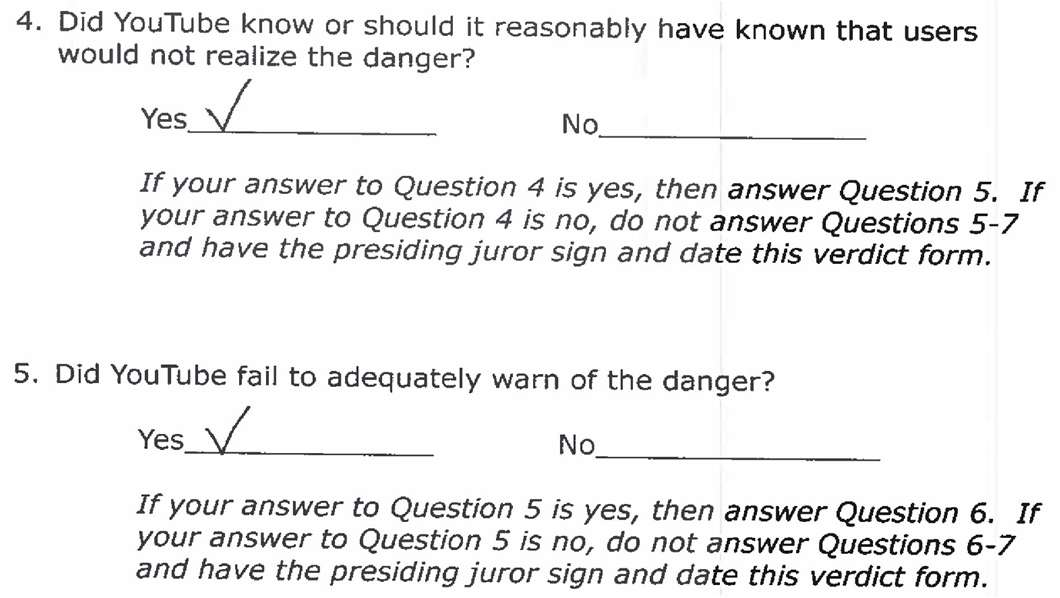
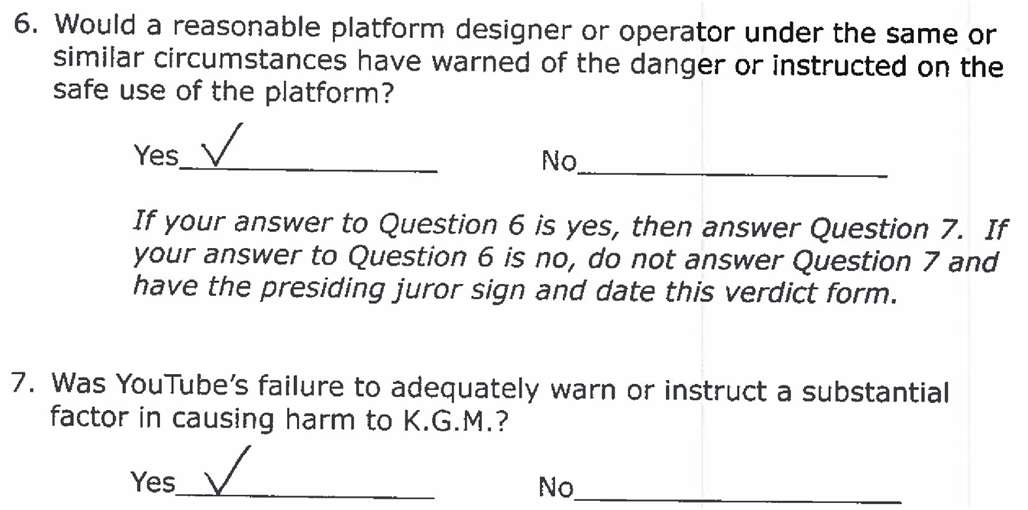
The jury also found that (i) YouTube knew or should have reasonably known that users would not realize the danger presented by YouTube, (ii) YouTube failed to adequately warn of the danger, (iii) a reasonable platform designer or operator under the same or similar circumstances would have warned of the danger or instructed on the safe use of the platform, and (iv) YouTube’s failure to adequately warn or instruct was a substantial factor in causing harm to K.G.M.:
As to damages, the jury found K.G.M. was entitled to compensatory damages of $3 million, with 30% ($900,000) allocated to YouTube, and 70% ($2,100,000) allocated to Meta.
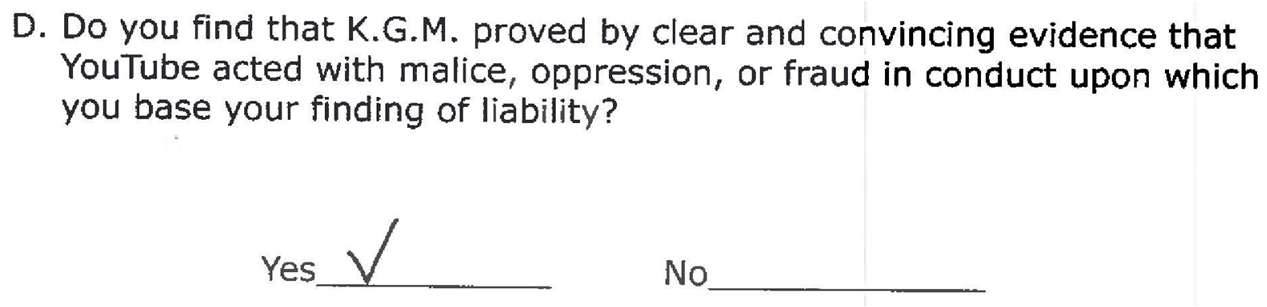
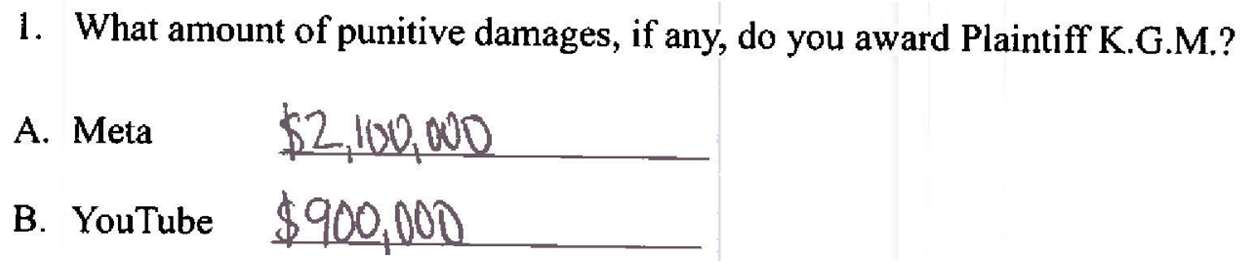
Even worse, the jury concluded that K.G.M. proved by “clear and convincing evidence” that YouTube “acted with malice, oppression, or fraud.” On that basis, the jury awarded K.G.M. $900,000 in punitive damages from YouTube:
As a result of the trial, a variety of internal YouTube documents have become public. Helpfully, the Tech Oversight Project has catalogued some of those documents online in a public report.7 The Districts should review that report.
The authors of the Tech Oversight Project report characterized the internal YouTube documents disclosed in the trial, dating from 2012 through 2025, as showing that “Google possessed granular, quantified internal knowledge that its products cause psychological and physical harm to minors — including sleep deprivation, compulsive use, and social displacement — yet systematically prioritized engagement metrics and advertising revenue over safety.”8
The Districts should also review other internal YouTube-related documents that have recently become publicly available and searchable in an online database.9 Over 200 documents relating to YouTube appear in that database. Like the YouTube documents highlighted in the Tech Oversight Project report, this evidence provides insight into plaintiffs’ allegations that YouTube sought to capture students’ attention and loyalty at the cost of their health, education, and safety.
Further, in the recently announced settlement between Meta and 48 State Attorneys General, Meta and the States have stipulated that Facebook and Instagram’s primary competitors are TikTok, YouTube, and Snap—which are defined as “Core Industry Members” under Meta’s multi-billion-dollar Consent Judgment.10 Indeed, certain of Meta’s obligations under the Consent Judgment, including certain payment obligations and platform changes, are contingent on YouTube and TikTok’s adoption of platform changes and payment of billions of dollars to the States.11
TikTok, Facebook, Instagram, and Snap are not permitted on school-issued devices, for obvious reasons. Yet, YouTube often is permitted. This makes no sense. These four platforms are direct competitors. None of them should be used by students on school-issued devices.
We now turn to Google’s defenses to YouTube-related claims by children and their families. As you will see, the implication of Google’s legal positions is that Google believes school districts bear 100% of the legal responsibility to protect children from the alleged dangers posed by YouTube—dangers which many of the Districts have already admitted in their MDL lawsuits.
c. Google Argues It Is Legally Unaccountable for Harms to Minors Caused by YouTube and Attempts to Shift Legal Responsibility to School Districts.
YouTube’s central defenses in the K.G.M. lawsuit are similar to those YouTube has raised in many other lawsuits related to harms to minors allegedly resulting from YouTube’s defective product design and addictive product design features. In addition to trying to blame the minor plaintiff and her family for her allegedly harmful use of YouTube, YouTube argued that two key legal defenses completely shielded YouTube from liability even if K.G.M. proved her injuries were caused by her allegedly compulsive use of YouTube:
- First, YouTube argued that Section 230 of the Communications Decency Act shielded YouTube from liability, on the theory that YouTube is merely a publisher of third-party content. K.G.M. defeated this defense by focusing on YouTube’s content-neutral design features, such as the “like” button, notifications, the algorithmic feed, infinite scrolling, and autoplay.
- Second, YouTube argued that the First Amendment of the U.S. Constitution protected YouTube from liability, again as a purported mere publisher of third-party generated content, apparently on the theory that YouTube has essentially unbounded freedom to deliver third-party content on YouTube to minors, however it likes. K.G.M. likewise defeated this defense by focusing on YouTube’s design features, not the content.
In effect, YouTube argues that its Section 230 and First Amendment defenses are so broad that they amount to a legal forcefield when YouTube allegedly harms children. Though K.G.M. defeated these defenses in her case, YouTube has appealed.
Setting aside the weakness of YouTube’s legal positions in this regard, the punchline here is clear: By hiding behind purported Section 230 and First Amendment defenses, YouTube is not taking legal responsibility for its product’s impact on children, including the millions of children entrusted to the Districts’ care and supervision. Therefore, it falls on the Districts to protect their students from YouTube.
d. Google Blames School Districts For Alleged Harms to Students in More Recent Chromebook Litigation.
The Districts should also be aware of more recent lawsuits against Google with respect to harms to children in schools resulting from their use of school-issued devices. Several parents have filed lawsuits against Google alleging that school-issued Chromebooks are a defectively designed product that harmed their children.12
The central allegations in these suits are that school-issued Chromebooks are dangerously defective products because they fail to prevent minor students from accessing harmful content like pornography on the internet and instead promote such content. The complaints further allege that Google failed to warn schools, parents, and students about the dangers Chromebooks pose to students—and instead marketed them as safe for use by children in schools around the country.
While these Chromebook lawsuits are in earlier stages of litigation than K.G.M.’s lawsuit against YouTube, Google’s motions to dismiss these suits strongly suggest that Google intends to blame school districts for alleged harms to students related to student use of school-issued Chromebooks, and that Google argues it is legally unaccountable for alleged harms to children resulting from their use of school-issued Chromebooks.
In one of these suits, an eleven-year boy, identified by the initials “M.C.,” was allegedly exposed to pornography on his school-issued Chromebook after searching for information about characters in Pokémon, a Japanese media franchise that features fictional animated creatures.13 The plaintiff alleged that Google’s algorithms pushed him toward increasingly sexualized content: what began with a search of “who was Ash’s girlfriend” (Pokémon characters) led to pornographic anime, which ultimately led the student to pornographic content depicting real humans.14
In its motion to dismiss M.C.’s lawsuit, Google immediately pointed the finger at the school district. On the very first page of its motion, Google asked the Court to throw out the case, arguing that “courts are not school boards or legislatures” and insisted the matter was better “addressed to local school districts, to the Legislature, and ultimately to the people in whom the power to develop public educational policy properly resides.”15 On the second page of its motion to dismiss, Google continued blaming the school district, arguing that school administrators could have restricted access to the internet.16
Next, Google argued that even if the safety settings and administrator tools made available to schools on Chromebooks are deficient, and fail to give schools the tools they need to protect their students, Section 230 still immunized Google from any legal liability for student harms caused by online content accessed by students on their school-issued Chromebooks.17
In other words, to Google, even if the “Admin” tools Google sells to school districts to protect children do not work, it’s still not Google’s fault – it’s always the schools’ fault.
In another lawsuit, a ten-year old plaintiff, identified by the initials “Z.G.,” sued Google for being victimized by a disgusting, adult predator on Discord, a dangerous platform she was able to access through her school-issued Chromebook.18 Z.G. alleged that Chromebooks are dangerous and defectively designed products and that the Chromebook administrator tools are defectively designed and ineffective in protecting children from online harms.19
In its motion to dismiss, Google again blamed the school district, arguing that school administrators could have prevented the alleged harms through use of the “Admin Console” in the GWFE.20 Incredibly, Google argued that Google could not have “caused” the child’s alleged injuries because, among other reasons, the school, not Google, issued the Chromebook to the student.21 This is analogous to a food vendor providing expired lunches arguing that it cannot be held responsible for poisoning students—because the cafeteria served their rotten food to students.
As to Google’s alleged failure to warn students, schools, and parents about the dangers of its products, Google argued there is no duty to warn of “generally known and recognized” dangers. To that end, Google cited a prior case holding that slingshot manufacturers did not have a duty to warn their product was dangerous—presumably on the assumption that Google’s Chromebooks are obviously as dangerous to children as slingshots and thus do not need a warning.22 Slingshots are not issued to millions of children at schools around the country. But Chromebooks are.
These lawsuits do not represent one-off tragedies. Rather, they are incredibly common. For example, Common Sense Media reported in January 2023 that 17% of teens aged 13 or 14 have been exposed to pornography on a school-issued device.23
By publicly pointing the finger at school districts, and seeking blanket legal cover from Section 230, Google is attempting to shift the legal risks of its products to the Districts.
Even worse, Google convinced many of the Districts to agree by contract to assume a wide variety of legal risks associated with Google products in schools. For example, Google may argue that by agreeing to the Google Workspace for Education Terms of Service, many Districts have agreed to indemnify Google if students are harmed by Google products on school-issued devices.24 The same goes for YouTube’s Terms of Service, through which Google has attempted to shift the legal risks of YouTube to the Districts through unconscionable indemnification terms.25 Google should be the one indemnifying the Districts for the risks of its products – not the other way around.
e. Recent Public Reporting Related to YouTube and School-Issued Devices Shows How Google Tries to Shift Blame to the Districts.
Since K.G.M.’s historic jury verdict against YouTube, multiple press reports have documented the widespread and problematic use of YouTube in schools.
For example, in an eye-opening article, How YouTube Took Over the American Classroom, in THE WALL STREET JOURNAL (April 29, 2026), reporter Shalini Ramachandran described a variety of horrific situations in which children compulsively used YouTube on their school-issued devices and viewed highly inappropriate and explicit content, often generated by YouTube’s algorithmic content and autoplay features.26
As set out in the article, in one case, a seventh grader viewed more than 13,000 YouTube videos on his school-issued device over just three months. Those videos, which include TikTok- like videos called “Shorts” – which children can rapidly scroll and which are driven by YouTube algorithms comparable to those at issue in K.G.M.’s trial – reportedly featured gun violence involving children, and sexually explicit content. Based on interviews with 45 families, school administrators, clinicians, and educators across the country, Ms. Ramachandran reported that “schools’ overreliance on the Google-owned platform for educational content has created a gateway for students to get sucked into an infinite scroll of videos on school-issued devices.”
In its comments on this reporting, Google again placed 100% of the blame for these situations on school districts, stating: “Our tools allow administrators to block the platform entirely or restrict access to teacher-assigned videos only, with no ads, recommendations, or browsing.” Again, to Google, this was all the school districts’ fault.
Public reporting has also drawn attention to growing resistance in school districts around the country to Chromebooks, reportedly in part due to the potential dangers they pose to students. These efforts were explored in a report from THE NEW YORK TIMES, Chromebook Remorse: Tech Backlash at Schools Extends Beyond Phones (March 29, 2026), by reporter Natasha Singer.27 Ms. Singer’s article even quotes California Governor Gavin Newsom, troubled by online content his school-aged sons were exposed to at school, as saying: “It was his school device … It was YouTube. It was the Chromebook and all these algorithms.”
In another article, ‘Teachers Are Going to Hate It’: How Social Media Apps Hooked Teens at School, THE NEW YORK TIMES (June 4, 2026), reporter Jennifer Valentino-DeVries carefully documented a decade-long campaign by social media companies, including YouTube, to increase use of their products by infiltrating schools.28
As to Google and Chromebooks, Ms. Valentino-DeVries cited another parent whose child had watched over 1,500 noneducational YouTube videos at school over six months, and documented Google’s business strategy of attempting to increase YouTube usage on weekdays by increasing its use during school hours. In its response to the reporting, YouTube again blamed school districts, noting that YouTube could be blocked by schools if they wanted to.
If these news articles were one-off, or poorly sourced, it might be easy to dismiss them. These articles, however, are consistent across reporters and publications, they are fact-based, and they all elicit the same basic comment from Google, which amounts to something like: Google is legally unaccountable for its products, so it’s up to school districts to protect children from them.
f. Google Recently Enabled Gemini AI Features on School-Issued Devices Without First Seeking Permission From Parents or Schools.
At the start of this school year, Google enabled Gemini AI features for millions of elementary, middle school, and high school students on school-issued devices—without first seeking permission from schools or parents.29 Therefore, millions of American students can now use Gemini to complete homework, summarize reading, create images, offload their thinking to an AI, and have open-ended conversations with an AI chatbot on their school-issued device.30
Natasha Singer of The New York Times reported that “Google’s drive to increase student access to its A.I. tools ramps up a longstanding battle among tech giants … to capture classrooms and secure students as long-term customers.”31 Common Sense Media noted that Google’s “move is part of a bigger pattern: Google adding features to student accounts and putting the responsibility on IT administrators to notice the changes. This defaults to adoption, rather than permission.”32
Just last week, reporters from The Wall Street Journal wrote that “[n]o tech giant has been more aggressive in putting AI in front of schoolchildren than Google” and that Google’s rollout of AI tools this year “has helped push many students to become academically and emotionally dependent on AI, according to interviews with more than 60 teachers, school officials, parents, children and clinicians.”33 This article also cited Google’s own research, which found that AI tools “can pose elevated risks to children” and “has potential for cognitive and emotional harm.”34
This reporting aligns with previous risk assessments of Google’s AI tools. For example, Common Sense Media’s Youth AI Safety Institute analyzed Gemini K-12 and concluded that it “surfaces inappropriate content, poses mental health risks, and has poor boundaries.”35 After testing, Common Sense Media found that “Gemini K-12 fails to recognize warning signs of mental health conditions.”36 As a result, Common Sense Media rated Gemini K-12 as “high risk.”37 The Districts should review this 30-page report, because it explains Gemini’s safety problems in detail.
Similarly, in a July 2026 report, Common Sense Media’s Youth AI Safety Institute performed a comprehensive risk assessment of the AI features built into Google Search—such as “AI Overview” and “AI Mode,” both of which are readily available to children at google.com through any web browser—and concluded that they “pose unacceptable risks to children,” the worst possible rating.38 The same risk assessment found that “Google's AI Overview and AI Mode repeatedly missed signs of kids in crisis, gave inappropriate advice, and produced answers that were inaccurate and unreliable for young learners.”39 Shockingly, the assessment also found that Google’s AI answers “missed clear signs of suicidal ideation (sometimes answering in ways that made things worse), played into delusions and paranoia, and validated disordered eating.”40
Notwithstanding these reports, Google has attempted to shift the legal risks of its AI tools to the Districts. For example, because Gemini is covered by the Google Workspace for Education Terms of Service, Google may argue that the Districts have agreed to indemnify Google for legal risks associated with student use of Gemini.41 Google’s AI playbook is similar to its playbook for other Google products in schools: It introduces the product by default, claims that schools could opt out if they wanted to, and attempts to shift the legal risks of the product to schools.
This is not OK.
II. School Districts Should Disable YouTube and Gemini AI on School-Issued Devices and Investigate Risks Posed By Student Internet Use More Broadly.
Putting this all together, the questions raised by recent litigation developments and media reports include the following:
1.) Now that over 1,000 Districts have sued YouTube in the MDL litigation, alleging that YouTube is a dangerous and defectively designed product that addicts and harms their students, how can the Districts defend allowing the same students to use YouTube on their school-issued devices?
2.) Now that a jury has found that YouTube is dangerous or likely to be dangerous when used by a minor in a reasonably foreseeable manner, how can Districts justify allowing their students to access YouTube on school-issued devices?
3.) How many students in the Districts are becoming addicted to YouTube, including YouTube “Shorts,” on school-issued devices? How many students are developing depression, anxiety, body dysmorphia, and suicidal ideation – like K.G.M. did?
4.) How many students are being harmed by their interactions with AI chatbots, like Gemini AI and Google’s AI Mode, on school-issued devices?
5.) How many students are being harmed by internet use on school-issued devices?
6.) How many families are going to file suit against YouTube, Google, and/or the Districts after they discover their children were harmed by problematic use of YouTube, Gemini AI, Google’s AI Mode, or other online content on school- issued devices?
7.) If lawsuits are filed, is Google likely to blame the Districts, as it has already done in the M.C. case, the Z.G. case, and in its public comments cited above?
8.) If families sue the Districts, and/or Google points the finger at the Districts, what actions will the Districts have taken to protect their students from harms caused by YouTube, Gemini AI, Google’s AI Mode, and internet use on school- issued devices?
9.) Will the Districts have failed to protect their students—even after becoming aware of those potential harms?
Now that the Districts know of the potential dangers to students posed by YouTube, Gemini AI, and internet use on school-issued devices, the Districts need to take decisive actions to protect students. To that end, the Districts should do three things, right now.
First, the Districts should immediately shut off student YouTube access on school-issued devices.42 Google itself effectively invited the Districts to do so in response to the public reporting cited above. Content filters are not enough, because filters do not mitigate any of the legal or safety risks described here.43 Every harm to a student in the Districts caused by YouTube on a school-issued device from this day forward is inexcusable. Snap, TikTok, Instagram, and Facebook have no place in schools – with or without content filters. Neither does YouTube.
Second, the Districts should immediately shut off Gemini AI access on school-issued devices. The Common Sense Media risk assessments and public reporting cited above disqualify Gemini AI from being forced onto millions of American students.
Third, the Districts should conduct a systematic review of student internet use on school- issued devices. As part of this investigation, the Districts should analyze the data on students’ internet use, including:
1.) Whether students are engaging in conversations with AI chatbots, like Gemini AI and Google’s AI Mode, on school-issued devices;
2.) Whether students’ internet use is addicting and harming students, including by causing negative mental-health outcomes like depression, anxiety, body dysmorphia, social withdrawal, and self-harm, like K.G.M. experienced; and
3.) How long students are spending browsing the internet, how many websites students are visiting, and how many tabs they are opening simultaneously.44 The Districts should have the data necessary to conduct this analysis. If the Districts lack this data—which would be a problem in and of itself—the Districts should request the data from their technology providers, like Google, who surely maintain browsing histories for students while logged in on their school-issued accounts.
The Districts are funded by the public, the Districts educate the public, and the Districts are accountable to the public. The Districts should therefore inform the public about the steps the Districts will take to investigate these risks to students. When that investigation is complete, the Districts should disclose the full results to the public, and the changes they will make to their technology policies to protect students.
Conclusion
Children are at risk of being harmed. If and when they are, Google has made clear it intends to point the finger at the Districts. The Districts should take action to protect their students by:
- Disabling YouTube on school-issued devices;
- Disabling Gemini AI on school-issued devices; and
- Performing a systematic review of student internet use on school-issued devices, and adjusting their policies accordingly.
If the Districts fail to take the actions called for above, we are deeply concerned that students will be harmed by their use of YouTube, Gemini AI, and school-issued devices more broadly, the Districts will be dragged into litigation resulting from those harms, and the Districts’ taxpayers will be left footing the bill. These are completely unacceptable, and completely avoidable, outcomes. Only the Districts’ leaders have the power to prevent these disastrous outcomes. The Districts should act. The Districts should protect their students and taxpayers.
We greatly appreciate the Districts’ attention to these matters.





-
 Emily Cherkin
-
 Dr. Jared C. Horvath